
Peggy Liu

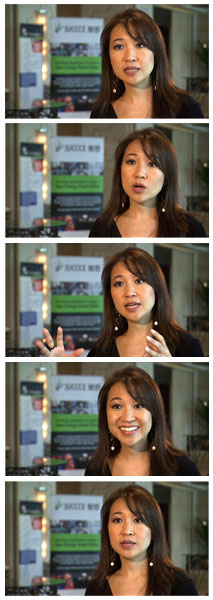
PEGGY LIU, interviewed at JUCCCE Mayoral Workshop in Beijing, China, June 30th, 2010
My name is Peggy Liu, and I’m the chairperson of JUCCCE, which stands for Joint U.S. China Collaboration on Clean Energy .
.
 : What does JUCCCE bring to the discussion of clean energy in China that is not available anywhere else?
.jpg) Well, JUCCCE is a non-profit, and we’re here to change the way China creates and uses energy. And we’re very unique in that we believe we have to tackle climate change as a change management issue, and not just a technology issue, or a policy issue. So a lot of the work that we do is identifying what those tipping points that China is just about to reach, and then we catalyze the group of international experts, domestic experts that we have around these issues.
Well, JUCCCE is a non-profit, and we’re here to change the way China creates and uses energy. And we’re very unique in that we believe we have to tackle climate change as a change management issue, and not just a technology issue, or a policy issue. So a lot of the work that we do is identifying what those tipping points that China is just about to reach, and then we catalyze the group of international experts, domestic experts that we have around these issues.
Let me give you a few examples. There are four main drivers of energy use in China. The first one is rapid urbanization in China. So if you look at McKinsey’s urbanization report they’ll tell you that over 20 years, we’re going to have 350 million people moving into cities in China, and we’re going to be building 50,000 new skyscrapers, the equivalent of ten Manhattans, 170 new mass transit systems. I mean it’s just an incredible, incredible scale. And so this all uses energy, and places a legacy of energy use that’s going to be with us for the next 50 years. So that’s one.
The other one is industry, and as people know, China is right now the factory of the world. What we’d like to do is turn it into the clean tech laboratory of the world. But the reality is that industry today uses 70% of all China’s energy. And so that’s a key driver of energy use.
The third one is the electrical grid, and I think people know that the electrical grid is like a backbone, the skeleton of all energy. And it’s really the bottleneck to using a greater amount of renewables in China, and so we’re focused on that driver of energy use.
 And lastly, consumer education and really turning students and press into green advocates. This is much more meaningful in China today than any other country, and I’ll give you the single reason why. Children, of course, are the voices of our next generation. But in China, if you’re familiar with our history, really we’re setting the habits of an entirely new culture, in these ten years. You know, we’ve really only been drinking coffee for ten years. Krispy Kreme just opened up on my block recently, in the last few months. So you can see this dramatic change in the habits of China, and they’re just like sponges. So what we want to do is set ways that they can make “energy smart” choices, consumers and, of course, the celebrities and press that influence the consumers.
So those are the contexts, the context of four key drivers of energy use. How JUCCCE plays a role is basically as a facilitator, and as a catalyst of changing the trajectory in each of those four drivers of energy use. Now China has a very unique landscape, decision-making landscape, compared to other countries. So what we do in JUCCCE isn’t necessarily completely 100% duplicatable, or replicable in other countries, because we have a little bit more centralized mindset, or decision-making system, in China. Now, it’s also very fragmented because we have over 660 cities, and tens of thousands of villages, but, um, in this centralized thinking, it allows us to make change happen at a greater scale at a faster pace.
So what we do is we identify who is, who’s the select group of decision makers in each of those four drivers of energies. Then we try to integrate and package solutions for them, whether it’s mayors in local cities, or the electrical grid, or a student in a school. Or a factory owner. If you can package solutions that they can deploy faster, this is a form of change management, a form of accelerating the greening of China.
Now why is that important to the rest of the world? Really, the greening of China is key to a healthier world. If you don’t have a green China, it’s not a set of butterfly wings, if you understand my meaning, a set of butterfly wings that affects the rest of the world. It’s a sledgehammer.
So it’s important, that as we have the JUCCCE China Energy Forum today, not only do we have the head of the U.S. Dept. of Energy in China, but we also have the Ambassador to New Zealand, and Head of Investment New Zealand, we also have Rajendra Pachauri, speaking about India-China collaboration, we also have celebrities like Tsein Ling, the singer, who’s very well-known in China, to other people that we work with, the actress Li Bingbing, who’s one of our top actresses, China’s first top supermodel Du Juan, to Loreal and Coke, and non-energy companies. So, changing the way China creates and uses energy is going to take a dialogue among many stakeholders, and this requires a facilitator that’s neutral, and allows people to understand how do they win, personally, how does their company or their entity, their organization win. How do we all win together, bigger, if we work together. So in other words, how does one plus one work eleven instead of two?
:What do many North Americans not understand about what’s happening in China?
So, I am Chinese American, so I was actually born in America. I most recently lived in Silicon Valley, but I’ve also lived in Connecticut and New York. I was born in Michigan, I’ve lived in LA. I’ve only recently come to China about six years ago, and what I realize going back and forth between the two countries, is that there’s a wide, wide gap in terms of the understanding of what’s really happening in China. And not just the statistics like we’ve blown through the wind targets that we’ve set, or the 11th Five Year Plan in reductions or emissions, or energy intensity per unit GDP, all those energy geeky statistics, it’s really the lack of understanding of the intent, and the mindset of where Chinese are coming from, and why this is so important to them to go green. So there’s terms in our society like harmonious society, héxié shèhuì, which is two models of society, economic growth in an environmental balance. So there’s those types of terms that if you’ve never heard of them, you don’t understand how deeply rooted balance of man and nature is to the Chinese people. So that’s one.
The other one is that if you look at the people attending our course, during these ten days, the mayoral training program that we have on energy smart cities and the people who are attending here, the speakers from Tianjin, any of the other SOEs (state-owned enterprises) that are speaking, you’ll see a theme which is, they already know they have to go green, but they need capabilities.
So it’s not about intent in China, it’s about matching it with capabilities of middle management, for example. “Well OK, I bought this cool boiler, how do I actually integrate it into my factory? Much less, you know, insulation, how do I put the waterproof membrane behind the insulation properly?” So there are all sorts of things that are required to really deploy technologies. It’s not just about the invention of new, cool or more efficient solar panels. You know, there’s so much more that’s involved.
And that’s where China is really struggling right now, because it’s going through so much change, and that’s where the international community can really benefit, by coming in and helping China. Because it is evolving, from the factory of the world to the clean energy laboratory of the world. What do I mean by that? I mean that China is throwing spaghetti on the wall right now, in terms of 27 different cities doing LED street lighting, or over 20, 30 different cities doing electrical vehicles, 40 different cities doing smart grid, etcetera, and it’s probably more, by the time you see this documentary. Right? The point is, that once they get that model that works, they are going to scale it and replicate it throughout the entire country faster than anyone can blink their eye. Or your eye. Faster than you can blink your eye.
So, for example, one day they just banned all free, thin plastic bags. All right? So now you have to pay a little bit for it and, you know, it enforced throughout the country now. Imagine what happens once we figure out a system for electric vehicles and the right charging station, and the right business model and the right financing model. That’s just going to blow through China very rapidly. What’s going to happen is China is going to come up with the solutions. China is going to come up with the clean energy solutions that are cost effective and can be deployed at large scale. In other words, solutions that everybody around the world wants.
: Why is it a problem if Americans don’t understand how much is going on in China? How does that change what Americans will do about clean energy themselves?
Americans and people around the world really need to understand what’s going on in China. Because it’s a missed opportunity. If you don’t come here now, and do joint collaboration, joint ventures, work with the Chinese to figure out how to create these cost effective, large-scale solutions. Because what’s going to happen is that another country is going to come in and work with the Chinese. I won’t mention any countries, but there’s a lot of people investing a lot of money in China because we can do pilots here very, very rapidly, at low cost. With less liability, and we both win. In some cases, like the “smart grid”, Duke Energy, one of our partners that we helped with market entry and Jim Rogers, the chairman is our honorary committee member, why are they, an American utility, here in China? Because not only can Chinese people do pilots quicker, but because of China, the State Grid sets the standards for China’s smart grid. Because of the scale, purchasing scale, that’s going to set standards around the world, the de facto standard. So it behooves everybody to work with China.
: China is #1 in solar panels, #1 in the biggest wind farms in the world… That’s great, but can China get to green without solving the clean coal conundrum? What can China do to clean up coal use in China?
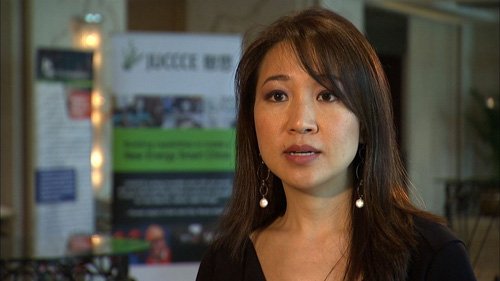 Clean coal is definitely one of the top priorities in China. And actually today we have someone from Shenhua, and they’ve spoken at our forums about what they’re doing. Um, some experiments in coal to liquid. There’s GreenGen, which is the equivalent of FutureGen in the U.S., so there’s Huaneng (see the sequence in ETOM #1 about the Shidongkou #2 carbon capture and sequestration plant, near Shanghai) and Peabody, who you may know, is involved in that. Duke Energy’s involved in that. So there’s a lot of companies that are all coming together to try and figure out different forms of clean coal, the production of energy from coal in a way that produces less emissions. As well as sequestering or burying the emissions into the ground.
I think what’s going to happen is, you’re going to see experiments and pilots succeed faster, in China. Now, some of it is just reducing emissions. It’s not about eliminating emissions. So it’s, I guess, the lesser of two evils, maybe that’s the wrong analogy. But, so “clean coal”, I don’t like to use that term necessarily. I like to use the word “cleaner” coal. So it might be higher quality coal, instead of using lower quality coal that produces greater emissions, finding a way to use the same coal or better quality coal to reduce the emissions for the same amount of energy produced.
So right now, today, you might not know this, but in three years, 2006-2009, while China was building that one new coal-fired power plant a week, it also shut down inefficient coal plants. The equivalent of seven percent of their entire power producing capacity. So, you know, it’s out with the old, and in with the new? And they’re really trying hard to invent new models. So I think what you’re going to see is a lot of the clean coal technologies come from China, more and more. It’s very exciting.
HEAR FROM THE EXPERTS:

|

|

|

|

|
- 1 of 2
- ››


 <
< <
< <
< <
<