
Steve Oatman

STEVE OATMAN, interviewed on the Double Heart Ranch in Sweetwater, Texas, August 25th, 2010
 <: So, just like we did on your patio, tell us who you are…
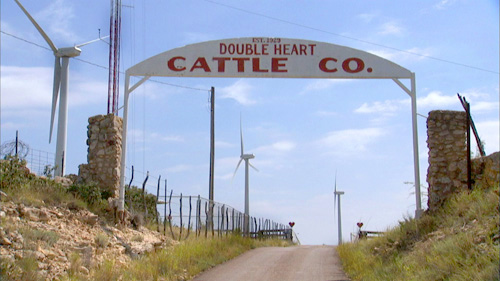
My name is Steve Oatman. I’ve lived here all my life other than a five year stint at Texas Tech University. “Go Raiders!” My granddad established this ranch right before the Depression hit. It’s called the “Double Heart Ranch”, and everybody asks how it got that name. Right after they bought the ranch, or signed the note for it, they looked at each other when the Depression hit, and they said, “How we gonna pay for this?” And they said, “Well, we’re gonna have to put our hearts into it.” So that’s how it got the name.
And since I got out of school I’ve been here. I’ve had a multitude of other jobs to supplement my ranching… hobby. But it’s a ranching heritage really. And really probably the most important job I ever had came in 1999 when we were in the 8th year of a drought. And that’s when the wind people first showed up out here, trying to lease land for future possible, future wind farms. And my Dad dealt with them, but what I told them was, I really, really needed a job, yesterday. And my Dad and I had three other ranches leased: we had to sell out and get out of that. I really needed the employment. And it turned out to be one of the best jobs I ever had. I met a lot of good people. I traveled all over the United States. Did very little work here around Sweetwater. Most of it was in New Mexico, Colorado, and up in the Midwest.
And what we did, was put up tilt-up towers and climb communication towers like that tower right there, and install instrumentation. It was wind forecasting, or prospecting is what it was. And that’s a very important ingredient before they build a wind farm. But they eventually built a wind farm out here, and we’re not really getting rich. We signed the first contract in Nolan County, but it’s been a blessing. It helps pay taxes, it helps pay the feed bill.
And like I say, most importantly, the job saved my life. You know, I would have found a job somewhere, but I found a great job. I didn’t get rich at it, but I loved my job.
But the wind industry is a big plus. It’s a big plus, and it’s something we’re gonna have to do. You know, I don’t just believe in it because I make a living from it. It’s something that’s going to have to happen for the country.
: Obviously there’s a lot of wind here. Is it good for Nolan County?
Oh, absolutely. Absolutely. You know, like you and I were talking about it. It employs a lot of people. It probably employs a lot more people when they’re building the site. It employs a lot of contractors and it’s just, it’s been a big plus for our town, and our county, and all the surrounding counties around here.
: As a rancher, how does it help you out?
.jpg) It helps me pay my taxes, and it helps me pay my feed bill, and it… I tell you what— one of the fringe benefits—they built probably 30 miles of road on this ranch. Not that the ranch is that big, but there’s a lot of roads out here, and they’re really nice roads. And that’s something me and my Dad always laughed about. That right there’s a great deal, because we can get to and fro so much easier. And the wind turbine people, I told you I worked with them for about seven or eight years—they’re great folks, you know. And they’re good to deal with, uh, I don’t have any problems with them. They don’t have any problems—well, they might not agree with that (smiles). But we usually get along great. You know?
It helps me pay my taxes, and it helps me pay my feed bill, and it… I tell you what— one of the fringe benefits—they built probably 30 miles of road on this ranch. Not that the ranch is that big, but there’s a lot of roads out here, and they’re really nice roads. And that’s something me and my Dad always laughed about. That right there’s a great deal, because we can get to and fro so much easier. And the wind turbine people, I told you I worked with them for about seven or eight years—they’re great folks, you know. And they’re good to deal with, uh, I don’t have any problems with them. They don’t have any problems—well, they might not agree with that (smiles). But we usually get along great. You know?
: Tell us a little bit about your ranch here. What do you have here?
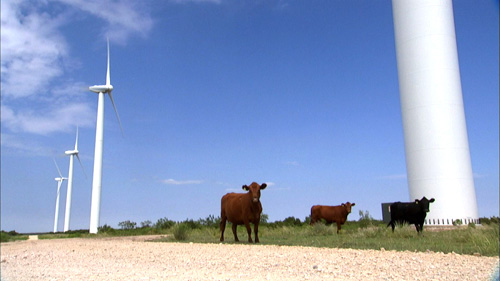
We used to run sheep and goats. My granddad told me that’s what paid for the ranch. But this is real brushy ,dry, rocky country. We don’t have much topsoil here. It’s sheep and goat country. But we can’t run sheep and goat anymore because the predators are so bad. And no one else runs ’em, so you don’t have your neighbors helping fight predators. We run only cattle now. And a few horses to help us, you know, do the cattle operation. Uh, when I went to work for the wind company in ’99, we sold out all our cattle, turned back the ranches my dad and I had leased, of course, we kept this ranch. We didn’t have any cattle for eight years. And my Dad passed away in 2005, and I started buying cattle back. One of my, one of the sites that I serviced for the wind company was out in New Mexico, and I bought some cattle out there, and I built that herd up to about 100 head now. Which is, that’s not a few, but that’s not a lot. But it’s been a long painful process (smiles).
: You, as a rancher, are probably more aware of how weather affects things… How does the weather affect the work you’re doing here?
Well, today it’s hot and windy, and it makes you miserable if you’re working in it. But, that’s part of West Texas, you know? You and I were talking about global warming a while ago, and I, I’m not, I agree that the climates are changing. Absolutely. Why they’re changing, I’m not sure. And I don’t think anybody is. When I was a kid we used to have two or three snows a year. Not big snows, but snows. And we would have at least one or two ice storms a year, big ice storms. And we used to get, seems to me, I’m only 57 years old (laughs) …only 57 years old. But we used to get a lot, seem like a lot more consistent rain, you know? And all of that has changed now. We have very mild winters. Hardly, if we get any snow, it’s a weird thing, like in April. And, uh, we been real fortunate the last five or six years. We got really, we haven’t had an onslaught of rain, but we’ve had plenty of rain to provide grass, you know.
So the weather can affect, you know, that’s the main drawback about ranching. There’s so many things that affect it. The market, the weather. But the wind industry: one thing we do have out here is pretty consistent wind and that’s something I’ve seen all my life. So this is definitely good wind turbine county.
Only problem is, when the wind’s really blowing, and they have curtailment, and there’s days when there’s thousands of turbines shut off because they don’t have transmission lines to get ’em to where they get that energy to where it needs to be. That should have been done before the fact.
: Do you feel comfortable talking about that a little bit more?
It’s been a really big problem for me. Like I told you earlier, it makes me want to bite a nail into it, when I walk out here and there’s… sometimes it will be a week that you’ll look around and every wind turbine you can see, about, where we’re standing, will be shut down. Curtailed, they’re shut off, because they don’t have anywhere to go with the energy. And to me, that’s really stupid. Because the government… we knew fifteen years ago this was coming. And it’s all, it’s all bogged down in politics. And it’s all about politics and money. And other energy sources, you know? Other energy sources don’t want to see wind energy. We’re cutting into their market. Yeah, I like to say “we,” because I’m very much wind, pro-wind.
: The green movement has always been behind wind. In the long run, you’re a long run kind of guy ’cos you’re a rancher, what are the benefits of wind?
In the long run? I hope they put, I hope we have wind turbines everywhere they can produce energy. We need ’em. That’s what America’s gonna have to do. That’s the next stepping stone to save ourselves. But in the process, whether we like it or not, we’re gonna have to use hydrocarbons. We’re gonna have to. That’s a stepping-stone to get us to clean energy. These wind turbines on our ranch, their life expectancy is 30 years. You’re talking about long term? I hope in 30 years they’re still running, and if they’re not I hope they replace them. And I hope it helps America.
 : And as an American, in terms of big energy, clean energy, the environment, do you think you guys out here in West Texas, there’s some way forward…?
Oh, absolutely, I think anybody that’s honest with the real facts out there, it’s a no brainer. You know? We’re in a dire situation. Uh …we were talking about the hydrocarbons a while ago. We know we’re going to have to do that whether we like it or not. Big problem with that is, we’re not getting them at home. We ought to be getting them at home. It’s utterly idiotic that we spend so much time and money and war trying to get ’em from another country, as they say, that doesn’t even like us.
HEAR FROM THE EXPERTS:

|

|

|

|
|
- 1 of 2
- ››


 <
< <
< <
< <
<