
Rear Admiral David Titley

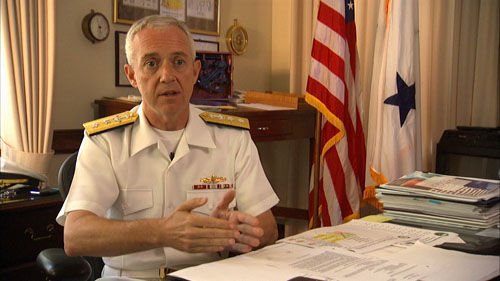
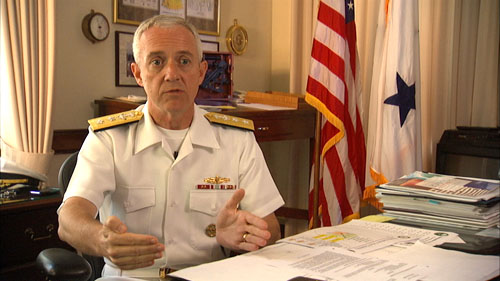
REAR ADMIRAL DAVID TITLEY, interviewed in his office at
the Naval Observatory, Washington DC, August 17, 2010
I'm Rear Admiral David Titley. I'm the Oceanographer of the Navy,
the Navigator of the Navy, and the director of the Navy's
Task Force on Climate Change .
.
 : And that's my first question: what is that, and what's its mission?
Task Force Climate Change was started in May 2009 by the Chief of Naval Operations, Admiral Gary Roughhead, to really initially answer the questions of "What and when does the Navy need to do, and what do we need to consider, for the Arctic?" But as we started to explore that question, we very rapidly realized that really the Arctic is simply the harbinger of much greater changes that will likely take place in the 21st century. And for our Navy to be ready and capable in the 21st century, we're gong to need to both understand those changes, leverage the best science available to predict within the bounds of that science, and finally adapt to those changing conditions as, as it's going to pertain to national security.
 : So the Quadrennial Defense Review, which we know you were a part of, said that climate change, energy security, economic stability, are inextricably linked. How will climate change affect the Navy's mission?
I believe climate change is going to affect the Navy's mission in several ways. In the near term, the changes in the Arctic are both very real and are happening very rapidly. Just this year, in fact in August of 2010, when you look at the extent of the ice, it is almost—not quite but almost—as low as the all time record minimum that was recorded in 2007. Perhaps even more significantly, when you look at the total amount of ice, which accounts for not only how much coverage, but also the thickness of the ice, that number is significantly lower now than it was at any time during 2007. So the observations are telling us without doubt, that the Arctic is changing rapidly. And the Arctic of course is an ocean, and we're the United States Navy, so we have, according to our Maritime Strategy, we have an obligation to think about the Arctic as an ocean just as we do the Atlantic, Pacific and Indian oceans.
: There have been some reports that "the ice is bouncing back," or "global warming stopped in 1998." You talk about a science-based approach to climate change: what does the science tell you about what's happening in the Arctic?
 I think what the science shows us in the Arctic is that the changes, if anything, are in fact accelerating. Again, we have worked with the Applied Physics Lab at the University of Washington and their Polar Science Center, and they have put together for us a very nice chart that is actually out on their website, anybody can look at it, that integrates or really puts together both the amount of ice, the extent of the coverage, and the thickness and the volume. washington.edu< And what that shows is a very consistent trend with a lot of noise. There's a lot of year-to-year variability, but the trend is very, very clearly down. And that trend, contrary to what some folks may have said after 2007, shows that the total amount of ice, again when you consider thickness as well as the coverage, is greatly decreased or less than what it was in 2007. So we really do not see any evidence, any observations pointing to a slowing down of the changes in the Arctic. And likewise, for the temperatures, really when you look at the globe, we see this continual increase.
One thing I think is important for people to understand when you look at the climate is climate is really averaged over decades: it's not just what you remember the weather was yesterday or three days ago. And the other part is, most of the heat—80+ percent of the heat goes into the ocean—so really to understand climate change we have to understand and better understand the oceans. And what I like to tell people is that the ocean climate really wags the atmosphere tail, and that's one of—not the only—but one of the reasons we see this year-to-year variability of the various natural cycles.
But natural cycles do not in any way mitigate or negate the fact that there is a significant man-made or anthropogenic component of climate change happening as we speak.
:(ETOM question about the character and speed of changes in the Arctic.)
I think the changes, from what I understand, are pretty consistent. I don't see any changes happening slower than what was forecast. There is a wide range of forecasts out there for when the Arctic will be ice-free. And people can discuss what the technical definition of "ice-free" is. But I think most people, most folks, would say, "Well, when I look out at the ocean, that would mean I don't see any ice." So that's a pretty reasonable definition. There are some scientists, again, and these are all respected scientists, they've published in peer-reviewed journals, (who) say that may happen as early as 2013, 2014. I think that's a little bit early. Other folks are saying as late as 2065. What I have told the Chief of Naval Operations is we expect to see about four weeks of basically ice-free conditions in the Arctic Ocean sometime in the 2030s, say 2035, 2036. So what that would mean is you may, you almost certainly will, have a day or two or a week before that time. But we think about a month or so of ice-free conditions by the mid 2030s. That's not that far away. That's 25 years from now.
: ETOM quotes the Pentagon's Quadrennial Defense Review: "Climate change will contribute to food and water scarcity, increase the spread of disease, and spur or exacerbate mass migration." Those don't necessarily sound like issues that should concern the U.S. military. Why should they?
I think the reason that those issues do concern the U.S. military is because food and water scarcity, potential migrations, significant upheaval in countries, can destabilize, in fact, the very, very world order. If you take a look at where some of the very significant impacts of climate change can be, in Africa, in Southwest Asia, in southeast Asia, these are all areas of the world in which the United States has enduring interests, for trade—frankly for just simply human dignity—for stability. So climate change is one of the factors that can potentially impact that. And once you start sort of pushing on that, that series of events, or many, many interactions, and it's very, very difficult to predict what that future will be. Take a look at the population, you take a look at demographics, you take a look at governance, you take a look at how do those cultures resolve contentious issues. You take a look at the various ability of different cultures and different nations to adapt to changing circumstances. How rapidly do those circumstances change? It's a lot easier to adapt, let's say, if you have a hundred years, than if you have five years to absorb or account for the same amount of change. So for all of those reasons, we in the United States military and certainly in the United States Navy are very interested. And we need to, to the ability we can, understand those types of changes, and that's exactly what the Quadrennial Defense Review is talking about.
: Picking up on that last point: the U.S. military has a long history of being the tip of the spear in humanitarian assistance because you have the logistics to be able to go in and do things… To what extent is climate change, the way we've just been talking about it, a humanitarian problem or a military problem?
I think climate change is going to really span that, that boundary if you will, between humanitarian and military problems there. There's clearly going to be some humanitarian aspect, and it's really going to, I believe, be seen not so much in the climate per se, but that climate, as the climate changes, will enable more specific extreme weather events. And it's those extreme weather events that will trigger humanitarian assistance in disaster relief.
And in fact, in August of 2010, the United States military is actively helping the country of Pakistan deal with some horrific flooding that is being caused by very, very active monsoons, rainy seasons, this year. So, the military has the capacity and capability to respond and in fact it is one of the six major missions in the United States Maritime Strategy that we will respond to humanitarian assistance and disaster relief where and when asked, and where and when we have the capacity to do so.
: You've been quoted as saying that one to two meters of sea level rise is within the cards for the end of the 21st century. How will sea level rise affect decisions about naval bases here in the United States?
There's… Sea level rise is going to be a long-term and very, very significant issue for the 21st century. And there is an organization inside the Department of Defense, called the Strategic Environmental Research Development Program, or SERDP. And SERDP is actually called out in the QDR as having the task for understanding the sea level rise. And at first blush, it's like, well, how hard can this be? If somebody says it's a meter, or a meter and a half, and you simply add a meter and a half to the surrounding area, and you can sort of doing an inundation study. But it turns out, like so much else in life, the devil is truly in the details, if you'll pardon the cliché, because there are really three components you have to understand about sea level rise.
 One is of course the global sea level rise, and we believe that because the glaciers both in Greenland and in West Antarctica are melting at an increasingly rapid rates—so that, of course, is ice that is on the land, it is flowing into the ocean—so that will raise the sea level rise, or will raise the sea level. There is the thermal expansion, or simply put, that warmer water takes up more space than colder water does, so as those oceans warm, that will also contribute. And then the smaller glaciers of the world. So that's the global part. That's the easy part if you will. And that part itself is still very tricky.
Then you have to understand what are the local currents? Because it turns out, that you never see this if you go to the beach, believe it or not, the sea itself is at different elevations. And again, it has to deal with large scale balancing of the currents, but it turns out that like on the Gulf Stream, on the east coast of the U.S., when you get into the warmer water, you've actually gone up maybe 20 or 30 centimeters from the colder water. You'll never feel that on a ship. It's very gradual. But there's a real difference. So you need to understand what the local currents are going to do.
And then finally, you also need to understand what the land itself is doing. For example, as I'm sure many people know, the land in the northern parts of the northern hemisphere, is actually still coming up, and that's an artifact, if you will, from the last Ice Age. (With the glaciers retreating, land is coming up.<) But as we know, on the Gulf Coast of the United States, for example, the land, for a variety of reasons, is actually coming down.
So there are three components we need to understand. The global sea level rise, local sea level as determined by local currents, and then finally what the land is doing. So once you put all of those together, and that's what SERDP is going to do, we can then start understanding the specific impacts of sea level on specific bases, and that then will be able to inform what our adaptation measures should be. Do you armor a base? Is it more wetlands? Do you raise the infrastructure so that you can work for a longer time?
The good news is even with one to two meters of sea level rise, which is very, very substantial—the sea level rose in the 20th century only 20 centimeters, so this is a factor of 5 to 10 times as much—but even with that, we have time. This is not a crisis, but it is certainly going to be a strategic challenge. But the opportunity is here for us to actually get it right. And to really understand things before we start spending money, the taxpayers' money, to do things. We really want to do the right thing here.
: That leads to a second question: spending money (implies) that it is real, and there's been some debate, some question about it being real. How certain is the U.S. military, is the Navy, are you about the reality of climate change?
Well, I think the QDR really talks about climate change in terms that really isn't for debate. And what I do, when I talk to folks, is I really take a look at the observations. And you take a look at the global temperatures, you take a look at sea level rise, you take a look at what the glaciers are doing, not just one or two glaciers but really glaciers worldwide, northern hemisphere, southern hemisphere, you take a look at what the ecosystems are doing. You take a look at where trees and flowers bloom. You take a look at what, at where they fish are living and where they're now being sighted. And you add all of those up together, and some of these, such as glaciers, are really very what we would call in science a low frequency. The glaciers are somewhat impervious to year-to-year variations, but they certainly respond to this low frequency. The deep ocean, deeper than 1500 meters, is a tremendous heat source. Even though it is only two, three degrees Celsius, but the fact that those waters are warming, albeit slowly, is a tremendous amount of heat. So we look at this low frequency change, and that's one of the reasons we really believe that climate is changing. So the observations tell us that. Physics tells us this as well.
NASA has done tremendous job measuring the output of the Sun, very accurately, really for the past 50 years. And plus or minus 1/10th. of one percent, the Sun has been constant for the last half century. NASA also is able to measure the amount of heat leaving the Earth, and we see in, right in the bands of where the so-called greenhouse gases, or gases like carbon dioxide is, that over time, less and less heat has left there.
And I think it just kind of becomes, it's physics, but it's also common sense in a way. If you think of the same amount of heat is coming into a system, but at certain parts, less heat is allowed to escape, then something has to change. And that something is the parts where heat can come out, in fact have to warm up, just to try to reach a balance.
Now the details of climate change, what's it going to be like in a specific place at a specific time, are very, very complex. And there are tremendous numbers of feedback mechanisms, many unfortunately accelerate, but some in fact retard climate change, and getting the details right counts. I mean everything is details, and details count.
But at the large picture, climate change is really pretty easy to understand. And the observations tell us it's happening
: To what extent does the U.S. Navy or U.S. military make its own independent observations of climate change, and to what extent do you rely on the evidence gathered by others?
We really work to gather the evidence by others. We work very closely with the National Academies of Science in this country. We work with our partners and our allies. I have a great relationship with the Royal Navy and the British—the title is Climate Envoy, I think it's a great title—by Admiral Neil Morissetti. (Editors: his full title is Climate and Energy Security Envoy) as an example. So really sharing the data throughout the science community, if it's open and transparent, allows people to frankly draw their own conclusions. But those conclusions are, I think, pretty straightforward on the large picture there. So, we're not in the Navy—I can speak for—is we are not interested in, you know, sort of re-inventing wheels. We are interested at helping where perhaps people haven't really looked before.
And one of the examples of that is we're working very closely with the National Oceanic and Atmospheric Administration, Department of Energy, NASA, and some other agencies to see whether we can really do better at the seasonal and annual and maybe the decadal type forecasting time. Because that's really where a decision maker is going to actually have to do mitigation, or really do adaptation. Because you start putting real money and real budgets in those times. So while we certainly want to understand what's happening in the year 2100—it kind of gives you a fix, if you will, a distant position you're kind of aiming for—it's those near term predictions, which frankly are the ones that are very, very hard to make, spanning that difference where weather tapers off and climate begins. There's a lot of science and research that will need to be done in here. But we're also pretty excited. This is, really, an opportunity here to get this right, and to provide something that will be of tremendous benefit – not only to national security and the U.S. military, but to just about every component of our society, all the civilian components. So they can better plan how to understand how the climate is going to really impact them.
: So you are pretty confident that the scientific community has got the basics of climate change pretty well understood?
Yes, I think the basics are really well understood. The National Academies have looked at this repeatedly. The Royal Society in Great Britain has looked at this repeatedly. I believe many people are aware that, post so-called "ClimateGate," there was almost a committee of committees of the various countries' professional scientific societies, chaired by a gentleman who is not a climatologist, who is not a meteorologist, but a very well-respected scientist. And again, the conclusions always come out the same – is that climate change is happening, and there is very, very strong evidence that a large part of this is, in fact, man-made.
: Mark Twain is quoted as saying everyone talks about the weather, but no-one does anything about it: What can the U.S. Navy or Pentagon do about climate change?
What we can do is really what we look for in Task Force Climate Change, is—one—to understand and predict this, and part of this is really what we can do is use this as an opportunity to work as a U.S. government and put together a national prediction capability, rather than having many agencies doing their own. We can use this, as I said, as an opportunity to really come up with a much more coherent and unified system. So that's one thing we can do.
Another part is the adaptations, but what we don't want to do on adaptations is, frankly, either get behind where we should be, or get ahead. Because there are tremendous pressures on the federal budget right now, on the budget of the Department of Defense, and that trickles down to the Department of the Navy. So we do not want to spend money on things that—let's say—may not happen for 50, 60, 70 years because we have pressing and urgent needs today. Conversely, we don't want to get caught short. So, this is why right now we are doing some fairly extensive studies to understand exactly what type of forces, of infrastructure, of communications capabilities would we require, when the Arctic opens up. So what we'll be doing about climate change is certainly thinking about the Arctic. In fact in August of 2010, we are at the request of the Canadian Navy, working with the Canadians in an exercise called Exercise Nanook off Baffin Island. We've sent a United States guided missile destroyer along with one of our maritime patrol aircraft and some divers, again, at the invitation of the Canadian Navy to gain better experience at working in Arctic conditions. So we want to understand what we need to do, we want to start training our sailors and our officers, and seeing how our equipment works. There's just no substitute for actually getting into that kind of environment and really understanding how this works. And we're really working with our allies, with the Canadians, the Norwegians, the British, and as an example, the Danes, so that we all kind of share lessons and work more closely up in the Arctic.
I should also add that we have a tremendous relationship right now with the United States Coast Guard, because when we look at the Arctic and how it opens up, probably some of the most urgent missions are going to be things like search and rescue, potential oil spill response. We've just gone through the Deepwater Horizon, I guess I would call it disaster, in the Gulf of Mexico, and if you think about it, that was probably the easiest place for us to respond. So imagine in the Arctic, what types of infrastructure would be required to respond, to an oil spill, either near or potentially under the ice. It really makes you think about what types of systems you would need to be involved in. So the Coast Guard certainly thinks about those. Admiral Chris Colvin—he's the commander of the Coast Guard district that encompasses the Arctic there—and I have a good working relationship, and that's another place where we really try to form a partnership.
: Without too many time references, because we hope to be on the air around Earth Day 2011, but we hope the program will be re-broadcast several times, and without getting too much of the "org chart" discussion, Bob (Freeman, Titley's public affairs officer) was telling us, and you just alluded to it, you were going to be part of a projection effort to look in to the future and get all U.S. government assets to pool information and work collaboratively: how well can we humans look into the future of the Earth's climate? How certain can we be of the possibilities that are out there?
I think that's a great question, is how certain can, can you be as you go further out into the future? And really the further you go out, for physical systems, you need to understand sort of what's the, what the big forcings are. So you need to understand as you go out, how much sunlight are you going to have? And we know this changes, from time to time, by some pretty well known orbit cycles. There are of course some smaller changes, shorter changes that we understand somewhat less well. The sunspot cycle is quite well known, but are there other variations in the Sun, and that is something that really that solar astronomers could probably better answer. We need to understand how much greenhouse gases will be in the atmosphere: part of that is controlled by humans. So what types of mitigations will we, as really mankind, collectively decide that we're going to do. That will change the climate. There are the so-called wild cards, the abrupt changes. You've got, people have probably heard of the so-called methane hydrates that are in the permafrost, and the bottom of some of the oceans. And if, if the permafrost warms sufficiently, that methane can come up into the atmosphere.
Methane is a very powerful greenhouse gas, however, unlike CO2 it has a relatively short stay time, a stay time that's measured in decades rather than in centuries. But how would that affect the long (sic) climate? I'm not sure anybody really knows. So all we can do is frankly the best that we can, the best that we can do. And that probably sounds trivial, uh, but if you start thinking about all the unknowns, there's almost a possibility that people will just throw their hands up and say, "This is too hard." And I don't think it's too hard. I think anybody who can tell you, or says that they can tell you, exactly what it's going to be like in 2100 at a certain spot at a certain time, I would run, not walk away from that person. But within scenarios, you can start having an understanding of the types of futures that are plausible. I wouldn't call them a specific forecast, or a specific prediction, but perhaps they're projections. And perhaps it's enlightening to us to understand the type of Earth that we will inhabit depending on choices that we make now and in the next few decades. And I think that can be useful for decision makers and really for populations at large, to kind of understand, what is the Earth that we will be leaving for our children, and our grandchildren, and their children.
: Putting your oceanographer's hat on, and thinking about a couple of those scenarios, the Business As Usual scenario and the feasible alternate universe scenario, what ocean do you see the Earth having, and what could it be with a growing population and the likelihood that energy would have a mix of different resources? As an oceanographer, what do you see those two alternate scenarios being?
If the world goes on the so-called Business as Usual scenario and we continue to use greenhouse gasses at what is now an accelerating rate as measured by the CO2 concentrations, and if we make decisions that really do not change that trajectory, for decades to come, it is not inconceivable that we would end up with a world with five, six, seven hundred parts or more per million of CO2. For what that would mean for the oceans, I think you have to think of not only how they warm, of how the Arctic changes from a mostly ice-covered or completely ice-covered at least right now, to one that has extensive time for ice-free.
But part of what would very much concern me is what I call the "silent cousin" of global warming, and that's ocean acidification. And really what this is, is it turns out that about 40% or almost half of the CO2 that we're putting into the atmosphere right now, doesn't stay in the air. It actually gets absorbed by the ocean. And through a series of chemical reactions, it turns the ocean slightly more acidic. I don't mean that we're all going to be in a hydrochloric acid bath, it's not that great a change. It's just like from a pH, which is just a way you can measure how acid, a water or a liquid is. Right now, historically, the ocean was about a pH of 8, 8.0. We're talking about moving that to 7.9, but in a "Business as Usual", it would maybe come down to 7.8, 7.7 …and those don't sound like huge changes, it's like "So what?" Well, the "So What" is is we've already seen a greater change, a change in that amount of acidity, or acidification in 150 years, that change is being more than has been seen in several hundred thousand years. So there's nothing magic per se about a pH of 8, but it turns out that all the ecosystems, the critters as I like to say—my guess my biologist-friends probably shudder as I say that—but they've all adapted and optimized themselves for a very specific water chemistry. And now, in the space of 100, 150 years, which is just a blink of an eye if you're a living organism or a species, we've changed that. And it's a real wild card as to how the ecosystems are going to adapt. If they adapt, and if they adapt fairly well, we're probably gonna be OK. If they don't adapt, and if the ecosystems …we start seeing major collapse in the ocean, one of the questions I would ask, really getting back to national security, is where do the one billion people who get their primary source of protein from, each day, where will they get that protein from? Because we already see stresses in agriculture, we already see that rice yields for example, in Asia, maybe impacted not so much by the daytime temperatures actually, by the fact that the nights aren't cooling down as much. I'm not sure anyone expected that. So it looks like there will be stresses on the land-based agriculture and if we really take out some of the ecosystems in the ocean, we've got a real problem.
: I don't know that the Navy has sent you to Las Vegas to figure out the odds of things happening but you did say that you'd like to have some "cards in your pocket"…
I have talked about one way to look at the environment in which we operate, is Nature's casino. And by predicting, and if you can successfully predict these projections and these outcomes, we can position ourselves to in fact adapt and ultimately to mitigate. And by that I mean I'm going to count the cards. So yes, we have these random events, or semi-random events, or sometimes forced by conditions, but the good thing is, is the science has advanced enough in oceanography, glaciology, meteorology, that we have some skill, at some timeframes, of predicting this. And if we choose to use those projections, we can in fact alter the future by our behavior, we can alter the future in our favor, and that's what I mean by counting the cards. The bad news is, there's a whole lot more than 52 cards to count here. The good news is, nobody's going to break my kneecaps if I get it right.
: What has the Secretary of the Navy said about trying to mitigate fossil fuel usage?
Well, Secretary of the Navy, Ray Mabus, has come out with some very ambitious energy goals to help the Navy reduce its carbon footprint. But I must tell you that the main reason we in the Navy are doing this, is we want to both increase what we would call our tactical flexibility: that is we understand that the more times a ship has to be alongside another ship to refuel, it's potentially vulnerable. If I can have an aircraft that gets a greater range on a mission, I can either launch that aircraft further away where I am less vulnerable, or I can have it either patrol the skies for more hours, or potentially go and do a mission further away from the aircraft carrier. So that's the tactical flexibility.
The strategic vulnerability is, we can just look at where do we get the oil, which countries are major providers? And I would argue that not all of those countries have the United States' best interest at heart. So if we can, in the Department of Defense, and the Department of Defense uses roughly two percent of the United States' carbon energy, or hydrocarbons, if we can reduce the payments of that, especially to countries, and it's a global market, it's very fungible, so that money, whether we buy it from a specific person or not, tends to go to the major oil producers, and again, not all of which have our interests at heart. So for those two reasons, the Secretary of the Navy is very, very committed to energy conservation and carbon energy reduction. (Secretary of the Navy, Ray Mabus…) He set several ambitious goals, the capstone goal if you will, is for the Navy to reduce its carbon footprint by 50% by 2020. And that's from a 2008 baseline. That's very ambitious. So, we are looking at things like how can we use biofuels? How can we use fuel that may be grown from algaes, as an example? How can we use more electric vehicles? What can we do for our bases, for both conservation and for green energy? CNO, Chief of Naval Operations (Gary Roughead), stood up a Task Force Energy in late 2008, it's run by Admiral Phil Cullen, and he spends much of his day thinking about these very, very issues. The byproduct of a Navy that is looking for increased tactical flexibility and reducing energy (in)efficiency, is by reducing our carbon footprint, we frankly provide leadership to the country, on this can be done, there are ways to do this. We're not going to go and live in caves. We're not going to (not) do our mission. The United States Navy will do our mission. Uh, but if we can do our mission at a significantly reduced carbon footprint, I believe that we can help show the way for the country on how to have our quality of life that we have all uh, grown up for, and frankly expect and demand, but by doing that with a lower carbon footprint.
: ETOM asks about what Admiral Titley would like to see happen in coming decades, and to which the Navy could contribute. (Question text not verbatim: recorder shutdown.)
Recapitalize our forecasting, forecasting of the ocean, forecasting of the weather, and how do we do that? And not to try and get overly technical on how we do that, but the models, or the computer code that was originally designed for this, was really built in the 1970s and early 1980s, and supercomputing was very, very different than what it is now, and what it's going to be in ten or twenty years. So we have to, sort of, recapitalize. Just as you have to every, maybe 5, 10, 15 years, go and buy a new car, because your old one just really isn't working anymore and it's getting expensive to maintain. Computer code is really the same. So we're at a juncture at our country where we're going to have to do this. And the opportunity is to do this as a nation rather than as multiple agencies. But what does that mean?
What that means is that, for the same amount of taxpayer money, a farmer in the Midwest, a surfer in southern California, can get a better forecast than what we have right now. And what we want to do is really extend in a seamless way, and this would be hard, but what we want to do is extend in a seamless way, your standard forecast from this afternoon, tonight and tomorrow, but we want to take this to where the science can, for what's it going to be this coming winter? What will the next summer be like? What will it be like in five or ten years? And this starts to really get into the climate. And as we understand the man-made component but also these many, many natural cycles, that sometimes work with, or amplify climate change, or some of the man-made components or sometimes work against it, it would really be nice if we could forecast that.
I live in Washington, DC, and in the winter of 2009, 2010, we had the snowiest winter ever. It would really be nice if, let's say, in that previous summer, if the weather forecasting and climate forecasting community could have given a warning to the mid-Atlantic states of "Hey guys, don't take a lot of money out of your snow removal budget, because you're going to need every penny and then some." That would have been really good. It would have been very useful if you're managing rivers and the nations' water supply, to understand that although January had the most snow cover of any year that's been measured in the United States in January 2010, by April 2010, we had the least amount of snow cover. So we saw a very rapid runoff. And you can start planning. You know how to manage your dams. You know how to manage your entire water systems if you have that kind of knowledge. So we think there's an opportunity here, to provide that knowledge. And we think that knowledge will be much… it's critical for national security but it extends way beyond that. And ultimately, we would like this to be able to affect people every day, so that they can make their own decisions with better knowledge than what they have now.
: Task Force Climate Change: If you had two or three scientific conundrums, mysteries, things that are not known at the moment, that would help the community, help the Navy, and help the nation move forward, what are the things that you would you like to know that you don't know at the moment?
If I could wave a magic wand at Task Force Climate Change, and get the information I needed, I would be very, very interested in knowing to as specific detail as I could, what will the climate be for the world, by region, for let's say, the next 5 to 30 years. And not only temperature, but precipitation, extreme events. There's a lot of debate right now, for example, in the weather community, as to will climate change increase either the number and/or the intensity of, like, hurricanes and typhoons. And typhoons are just hurricanes, what we call hurricanes in the western Pacific. It's a very important question. Because if you expect there would be more hurricane years like 2005, for example, when Hurricane Katrina went ashore, and many others in that year, you would probably plan differently than, let's say, for 2008, in which we had very, very few tropical cyclones. If you had some assurance at understanding that, if you had some assurance at understanding how much, where would the rainfall be distributed? How is it going to fall? If you understood that hypothetically, the temperatures and the climate may not change much between, let's say, 2015 and 2020, or 2025, but then starting in the late 2020s you would have an extremely abrupt rise to a new level. If you could forecast that with confidence, that would be very, very useful for decision makers as we plan budgets, and we know when and where how to adapt. That science is not there yet, but if I had one wish, that would underpin much of what we're trying to do on the adaptation front.
: The military is famous for contingency planning, thinking of the possibilities that are out there. In terms of climate change being a very serious threat to the nation, is it your perspective, is it the Navy's perspective, that climate change is a certainty, a possibility, a likelihood, a contingency, or what…?
Well, climate change, I believe, is a certainty. What is not certain is how will climate change specifically affect different areas of the world. We understand the Earth is getting warmer, we understand the oceans are getting warmer: what we do not understand is exactly how that will affect things like strong storms, uh, rainfall rates, rainfall distribution. So yes, climate change is a certainty, but what I need to plan for is I need to plan for what is it going to be like in specific regions of the world and when. And that's much less certain, so we'll right now, until the science can catch up with that, we would need to fall back on things like various scenarios. So we're not going to put all of our proverbial eggs in the one basket. But we will try to understand different scenarios. And then what we can do, is after going through a number of scenarios with different climate projections, kind of take a look at those scenarios. And are there common capabilities, forces, training, that sort of would answer either all or many of those scenarios, and those types of insights then give some real useful uh, tools, when we ultimately have to put together our budget, and decide what we have to do with our people, and what we have to do with our time. So although the Navy and the DOD, we do have a large budget, but it's finite. And there are more demands than we have the ability to meet. So what we need to do, is what do you do with your money, your people and your time? And if we have the tools that best show, again, where we would likely get the greatest return, or as I said, I'm counting the cards, I want to put the odds in my favor. Those are the areas in which we need to invest and adapt.
HEAR FROM THE EXPERTS:

|
|
|
|
|
- 1 of 2
- ››


 <
< <
< <
< <
<